Chief of Staff and Director of Transformation: two complementary roles or two roles that overlap?
Forces involved
The role of Transformation Director has existed for several years, with more than 700 professionals listed on LinkedIn in France. The role of Chief of Staff corresponds to more than 2,000 profiles in France, with a sharp increase in numbers since 2022.
It should be noted that these two functions can coexist. This coexistence is more common in large groups and less so in SMEs/mid-cap companies (or in contexts with limited resources), where it is more likely to see a combination of roles.
Thus, it is quite logical that these two functions can sometimes be confusing given their highly strategic nature. strategicand cross-functional nature and the crucial role they play in the organization's ability to execute.
We believe that it is important to distinguish between the two roles, which address different needs for senior management, and we aim to clarify them in this article.
Understanding Roles
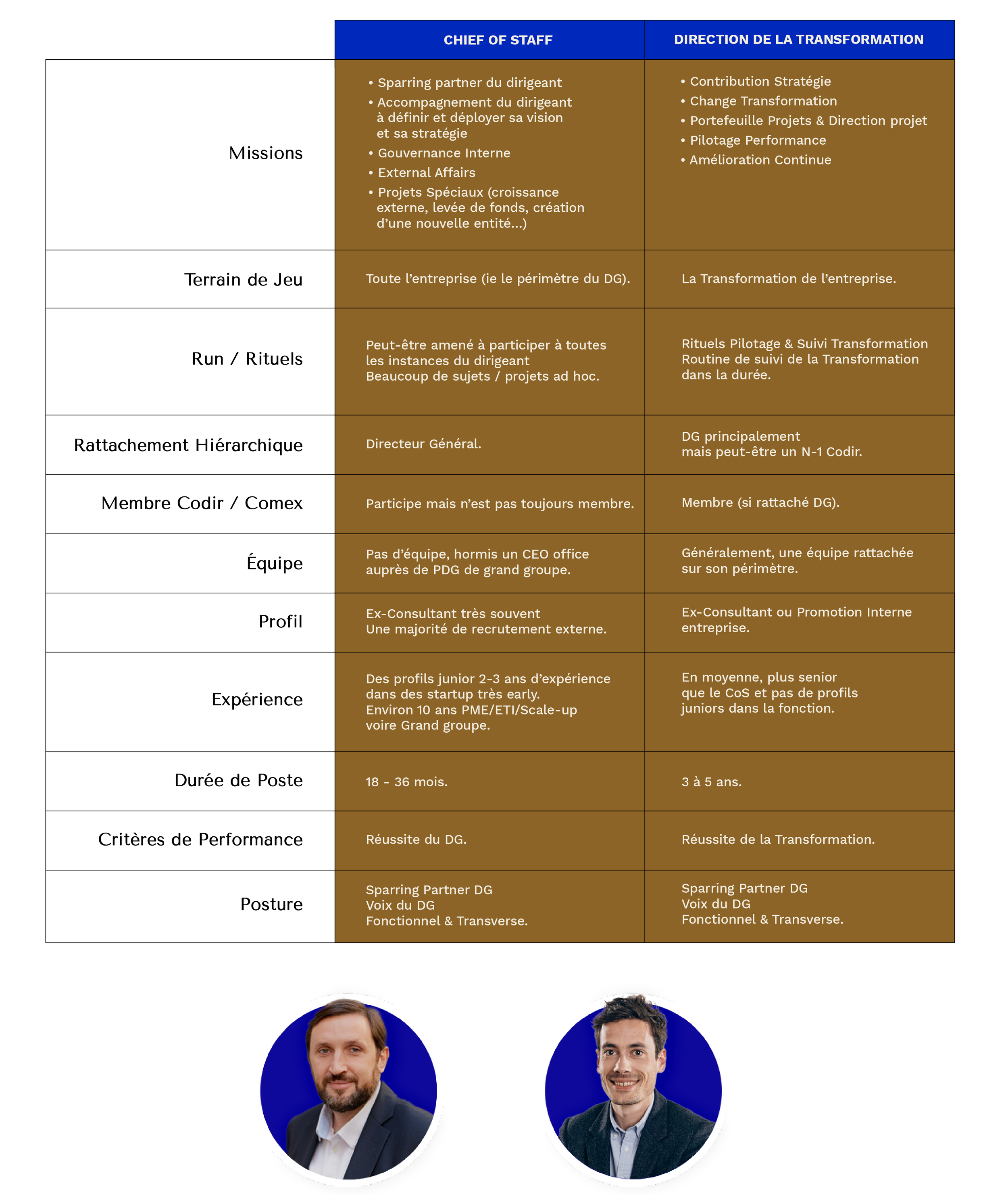
The Chief of Staff (CoS)
The Chief of Staff (CoS), sometimes referred to as the right-hand man, Swiss Army knife, "exoskeleton" of the leader, or Chief of Staff, is essential to maximizing the leader's effectiveness.
This role involves managing the strategic agenda, ensuring effective internal governance, and prioritizing key decisions.
When managing the strategic agenda, the Chief of Staff (CoS) must have a thorough understanding of the leader's priorities in order to optimize resources and ensure smooth communication with internal and external stakeholders.
By ensuring effective internal governance, the CoS provides strong coordination and strategic support, working closely with the CEO and all members of the Executive Committee, even without direct supervision of a team.
By prioritizing key decisions, the CoS is involved in various cross-functional projects and can take on certain strategic projects independently, thereby multiplying the executive's ability to implement their vision and the company's strategic plan. Examples include an organizational transformation plan in SME or mid-market organizations, external growth, or the drafting of a new strategic plan.
His playing field is that of a leader, acting as a sparring partner and confidant who shares a 360° view of the company. In addition to his role as a facilitator in internal governance, the CoS manages relations with external stakeholders (investors, banks, political institutions, etc.).
“The Chief of Staff's main KPI is the success of the executive they work for.”
The Director of Transformation
The Chief Transformation Officer focuses on implementing long-term structural changes. Unlike the CoS, his or her playing field is the company rather than the CEO. He or she is involved in defining and implementing strategy, ensuring that transformation objectives are fully integrated into the company's plans. This role often includes digitization, process reorganization, and adaptation to changing markets.
Unlike the CoS, the Transformation Director generally has a team to supervise. This team is dedicated to managing transformation projects, change management, and supporting teams in the transformation process. The Transformation Director is often a member of the Executive Committee (in companies where he or she reports directly to the CEO), whereas the CoS is not always a member of the Executive Committee, even though he or she plays a central role.
“The KPIs of the Chief Transformation Officer are therefore indicators related to the transformation of the company.”
Differences and Points of Porosity
Theoretical Differences
The main difference lies in the approach and scope of responsibilities. The Transformation Director is often tasked with long-term projects with specific structural transformation objectives. They work with clear deadlines and defined performance indicators. Transforming a company can take several years and requires careful planning and rigorous execution. This explains why a Transformation Director often remains in their role for between three and five years.
On the other hand, the CoS must demonstrate considerable flexibility and an ability to manage the unexpected. They often work on projects lasting between four and 12 months, which can be very varied. For example, they may go from managing a roadshow as part of a fundraising campaign to conducting operational due diligence within the space of a few days. As catalysts at the start of projects, their role is also to pass the baton correctly and at the right time.
Convergence Zones
Both roles are characterized by their cross-functional nature. The CoS and the Director of Transformation oil the wheels of the company, facilitating communication and coordination between different departments. They play a crucial role in ensuring the smooth running of internal processes and the success of cross-functional projects. As such, they operate in a more functional than hierarchical role within the company.
Due to their proximity to the CEO and their knowledge of strategy and decisions, they must be able to speak on behalf of the CEO and be able to make decisions and judgments on his or her behalf.
Both roles correspond to a kind of "internal super consultant." As such, the profiles are similar and very often come from a background in consulting at strategy or organizational consulting firms.
There are also similarities between the role of CoS and that of Transformation Director: the skills acquired as CoS, particularly cross-functional strategic coordination and communication management, can be transferable and useful in a Transformation Director role, especially when a company is evolving and requires increased change management skills. Conversely, the project and change management skills acquired as a Transformation Director are a valuable asset for a future CoS.
Impact of Company Size
The size of the company strongly influences the nature and coexistence of the roles of Chief Transformation Officer and Chief of Staff (CoS).
In large companies, these two functions can coexist and complement each other. They focus on complex, broad, and cross-functional issues with more segmented activities.
In SMEs, mid-sized companies, and scale-ups, it is less common for both roles to coexist. Due to a lack of resources, these companies often favor combining functions or choosing between one of the two roles. Responsibilities are more operational and hands-on, with a wide variety of tasks.
In startups, we find the role of CoS alongside the CEO and almost never that of Chief Transformation Officer.
Conclusion
If the size and resources of the company justify it, we believe that it is beneficial to have both functions within the company in order to maximize the chances of successful execution (of the plan, projects, management decisions, etc.).
Of course, the ideal world does not exist, and it is therefore possible for one person to wear both hats. Having a Transformation Director who acts as Chief of Staff or a Chief of Staff who oversees Transformation is not a problem in itself and can work with the right profile.
However, it is necessary to clearly distinguish between these two roles in order to be clear about expectations, the scope of legitimacy, and performance criteria.
Co-written by Axel DE LA FOREST DIVONNE - Senior Manager at Stanwell Consulting (https://stanwell.fr/), a firm specializing in business transformation, and Thomas BREUIL - Co-founder of 359 - The Chief of Staff Company.